What Does Hell Look Like?
Ask most people to picture hell and you’ll get the same image: caverns of fire, devils with pitchforks, endless screaming. It’s vivid, it’s culturally everywhere — and a surprising amount of it comes not from any scripture but from a 14th-century Italian poem. The traditions themselves are both stranger and more divided than the cartoon: they disagree, sharply, on what hell looks like, who goes there, and whether it lasts forever. Separating the inherited picture from what the sources actually say is the honest place to start.
The classic picture — and how much is Dante
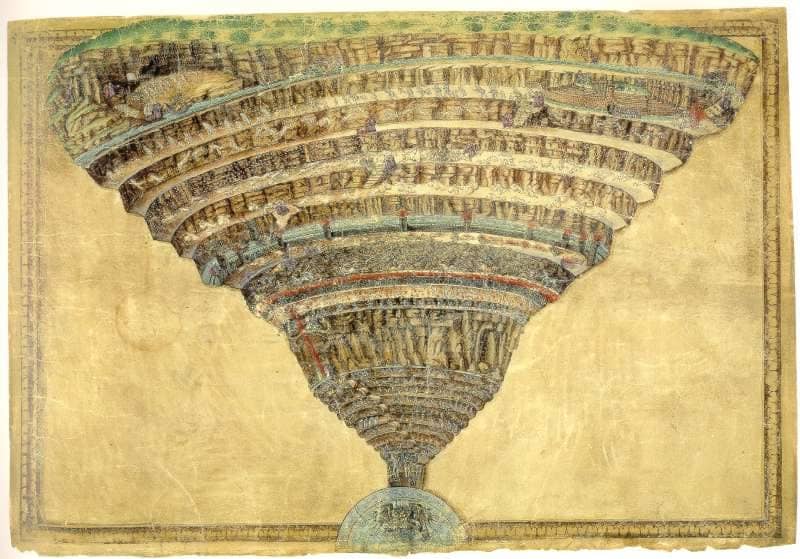
The popular hell is largely Dante’s. His Inferno — nine descending circles, each with its tailored torment, Satan frozen at the bottom — fixed the Western imagination far more than any verse did, and Doré’s engravings of it became the pictures in our heads. It’s a work of poetic genius, not a doctrinal map.
Scripture is sparer and less cinematic. The images are mostly two: fire and darkness. Jesus speaks of “everlasting fire, prepared for the devil and his angels” (Matthew 25:41) and of “outer darkness.” The New Testament’s word Gehenna refers to a literal burning rubbish valley outside Jerusalem — a real place repurposed as metaphor. Revelation gives the “lake of fire” (Revelation 20:14). Notice the tension already: fire and darkness are hard to picture together, which is one clue the language is symbolic — pointing at a reality more than painting a postcard.
What hell actually is — where the traditions split
Set the traditions side by side and the disagreements are bigger than the agreements.
Islam describes Jahannam in vivid detail — fire, levels, real consequence — but always under God’s mercy and justice. Judaism, strikingly, mostly does not teach an eternal hell at all; in much rabbinic thought Gehenna is a temporary state of purification lasting up to twelve months, closer to what Catholicism later called purgatory than to eternal torment. The Indian traditions have Naraka — hell-realms that are genuinely terrible but temporary, a station within the cycle of rebirth rather than a final destination; you suffer the consequences of action, then move on. So the single biggest question — is hell forever? — gets three different answers across the world’s faiths: eternal, temporary-and-purifying, or temporary-and-karmic.
The modern reframe: separation, not a torture chamber
Even within Christianity, the picture has shifted. Many modern theologians reject the cosmic dungeon and describe hell as separation from God — the self-chosen absence of the source of all good, rather than torture inflicted from outside. C.S. Lewis put it memorably: the doors of hell are “locked on the inside.” In this reading the fire is the imagery of loss, not literal flame. Others hold to annihilationism (the lost simply cease to exist rather than suffer forever), and some to universalism (that all are ultimately reconciled). The honest picture of “what hell looks like,” then, depends entirely on which of these you’re describing — and serious believers hold each.
A note on the near-death accounts: the great majority are overwhelmingly positive, but a minority do report distressing experiences — darkness, isolation, fear. Researchers who study them treat these as real and important rather than hiding them; they’re far rarer than the luminous accounts, and experiencers often describe being drawn out of them toward the light. It’s an honest part of the record, not the dominant one.
What we actually know
The honest accounting: much of what we “know” hell looks like is cultural inheritance — Dante and the painters more than the scriptures — and the texts themselves use fire and darkness as symbols pointing at a reality they don’t pretend to photograph. We can’t confirm any of it, and we can’t even get the traditions to agree on the most basic question of whether it’s eternal.
What can be said plainly is that the disagreement is the story. Eternal torment, temporary purification, karmic consequence, self-chosen separation, simple oblivion — these are genuinely different pictures, held by serious people, and “hell is a lake of fire forever” is just one of them, not the consensus the popular image implies. Whether any of them is real is a question no one can settle from this side; we treat the existence question directly under is hell real?. What it looks like, the sources suggest, may be the wrong question — the truer one is what it would mean, and on that they part ways.
Existential Atlas maps these perspectives with the original sources side by side. Is hell real? → · or explore the question yourself.
Frequently asked questions
What does hell look like according to the Bible? Sparer than the popular image — mostly two symbols, fire (“everlasting fire,” the “lake of fire”) and “outer darkness.” The detailed circles-and-pitchforks picture comes largely from Dante’s Inferno, not scripture. Is hell real? →
Is hell eternal? The traditions disagree sharply. Much of Christianity says yes; Judaism often treats Gehenna as temporary purification; the Indian traditions place hell-realms within the rebirth cycle as temporary; and some Christians hold to annihilation or universal reconciliation. There’s no single answer. What is purgatory? →
What is hell, really? Beyond the imagery, many modern theologians describe hell as separation from God — a self-chosen absence rather than externally inflicted torture (C.S. Lewis: the doors are “locked on the inside”). Others read the fire more literally. The description depends on the theology. Is hell real? →
Do near-death experiences describe hell? The great majority are positive, but a minority report distressing experiences — darkness, isolation, fear — which researchers treat as real if far rarer, and from which experiencers often describe being drawn toward the light. Near-death experiences →