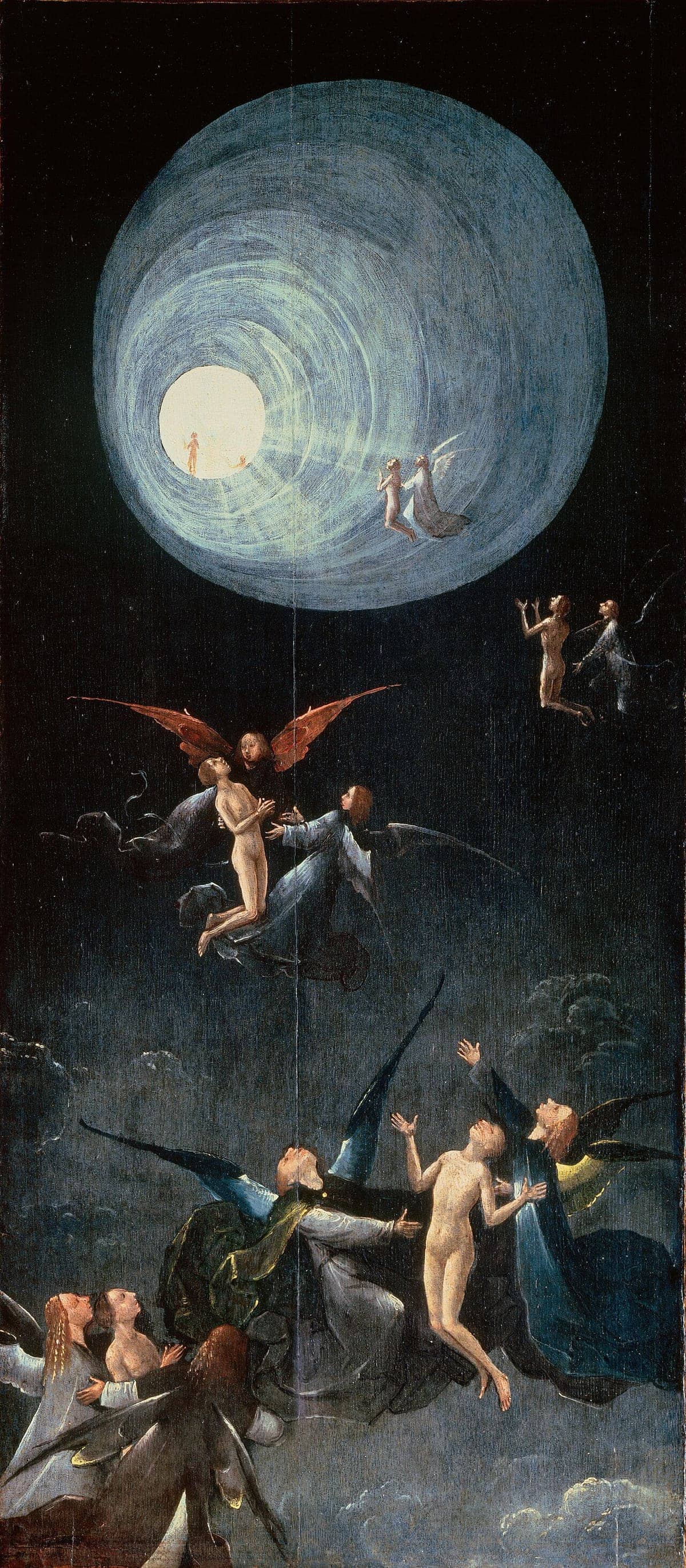
Near-Death Experience
Some people stop breathing, lose a pulse, register no brain activity — and then come back. And a striking number of them come back with a story. Not a vague impression of darkness, but a vivid, ordered account: of leaving the body and looking down at it, of moving through a passage toward a light, of meeting people long dead, of seeing their whole life replayed in an instant. We call this a near-death experience, and it is one of the most carefully documented and least explained phenomena in modern medicine. What makes it impossible to dismiss is not any single account. It is that the accounts keep matching — across continents, across centuries, and across people who had never heard the others speak.
What is a near-death experience?
The term near-death experience was coined in 1975 by Raymond Moody, a young psychiatrist who had collected dozens of cases of patients who reported lucid experiences while close to death. His book Life After Life named the pattern and started a field. Since then the loose definition has held: an NDE is a coherent, often profound experience reported by people who were clinically near death — in cardiac arrest, deep coma, or otherwise without the brain function we assume is required for any experience at all.
What unsettled researchers was not that dying people reported something. It was the consistency of what they reported. The psychiatrist Bruce Greyson, who spent decades studying these cases at the University of Virginia, built a standardized scale to measure them precisely because the elements recurred so reliably that they could be scored. You do not build a scale for noise. You build one for a pattern.
And the pattern is what this whole subject turns on. So it is worth walking through it, piece by piece, because each element on its own is strange — and together they are stranger still.
What are the common elements people report?
Pull thousands of accounts together — as Jeffrey Long has done at the Near-Death Experience Research Foundation, now holding well over 4,000 cases in a public database — and the same handful of features surface again and again, in roughly the same order.
It usually begins with separation from the body. People describe their awareness lifting out and watching the scene from above — the operating table, the wreck, the resuscitation. They report it calmly, often noting that they felt more awake than usual, not less. Some recount details of the room or the procedure they had no ordinary way of perceiving.
Then, frequently, a passage — the tunnel, a darkness with movement, a sense of traveling toward something. At its end, almost universally, the light. Experiencers are emphatic that this is not merely bright. It is described as aware — a presence that feels like overwhelming, intelligent love. Many encounter beings: figures of light, or relatives and friends already dead, sometimes people they did not even know had died. And running underneath much of it is the boundary — a line, a river, a fence, a felt limit — and the knowledge that to cross it is to not return.
Then comes the element that, more than any other, makes the literature hard to look away from: the life review. We will come to it on its own, because it deserves it.
You do not have to accept any explanation of these features to notice the thing that matters: they are not a menu people pick from. They arrive together, in sequence, reported by strangers who never compared notes.
The life review: why it’s the strangest convergence
If one element carries the weight, it is this. People describe their entire life replayed — not as a summary but panoramically, every moment at once — and, most remarkably, re-lived from the perspective of the people they affected. They feel the hurt they caused as the other person felt it. They feel the kindness they gave as it landed. No god is described handing down a verdict. They are simply, finally, seeing.
What makes this load-bearing is that it is not new. Long before any cardiac monitor existed, traditions reached for the same image. In ancient Egypt the heart of the dead was weighed against the feather of truth while the person looked on (Book of the Dead, Spell 125). Nearly every major religion holds some version of a reckoning — a life seen whole and accounted for. For most of history this was framed as judgment from outside. The modern accounts describe something the old texts almost never named: the reckoning seen from inside, by you, through the eyes of everyone you touched.
That an Egyptian scribe and a 21st-century heart-attack survivor reach for the same picture — a life laid bare and measured by how it touched others — is the kind of overlap that is very hard to explain by coincidence. (Watch a firsthand account of the life review → (Ishtar Howell)) We will not tell you what it means. We will only say the pattern is real, it is ancient, and it keeps repeating.
Who has actually studied this?
This is not folklore passed around online. It has been the subject of serious, decades-long, peer-reviewed research, and naming the people matters — because the credibility of the pattern rests on the rigor of the people who refused to wave it away.
Raymond Moody named the phenomenon in 1975 and gave it the vocabulary we still use. Bruce Greyson and his colleagues at the University of Virginia’s Division of Perceptual Studies spent over forty years cataloguing cases and built the standardized scale that lets researchers measure them. The cardiologist Pim van Lommel ran a prospective study of cardiac-arrest survivors published in The Lancet in 2001 — meaning his team identified patients in advance and interviewed them systematically, rather than collecting stories after the fact. A meaningful fraction reported clear, structured experiences during the very window when their brains should have been incapable of producing any. Jeffrey Long, a radiation oncologist, founded the Near-Death Experience Research Foundation and assembled the largest public archive of firsthand accounts in existence. And the International Association for Near-Death Studies has connected researchers and experiencers since 1981.
None of them claims the case is closed. What they share is a refusal to pretend the data isn’t there. The experiences are real in the only sense that matters scientifically: people reliably report them, the reports cluster, and the clustering does not go away under scrutiny.
What changes in the people who come back?
There is one more convergence, and for many experiencers it is the most consequential — and it has nothing to do with theology. It is about what happens to the living after they brush the edge.
The most consistent aftereffect in the entire literature is this: the fear of death recedes, and usually it does not return. People come back not hoping but convinced that they will be all right, and they rebuild their lives around that conviction. Status thins out. The people they love come into focus. Many describe a new, almost stubborn sense of purpose. This is the same arc the contemplative traditions always pointed toward — that to genuinely face death is, somehow, to be released from it. The Stoics rehearsed it on purpose; Marcus Aurelius reminded himself that dying is only doing what nature asks (Meditations). The experiencers had it happen to them by accident and came back changed in the same direction.
You do not have to believe anything about an afterlife to notice the shape of this. (Watch an experiencer describe losing the fear of death → (Journey to the Other Side)) Whatever an NDE is, the people who have come nearest to death tend to lose their terror of it — and to find their lives more vivid, not less, on the far side of that loss.
How consistent is it across cultures?
A fair objection: maybe people just describe what their culture taught them to expect. The accounts answer it better than you might guess. The deep structure holds across radically different backgrounds — the separation, the light, the beings, the life review, the boundary — reported by Christians and atheists, Hindus and skeptics, scientists and children too young to have absorbed the script. The surface details bend to the experiencer: one person reads the being of light as Christ, another as a grandparent, another simply as love. But the underlying grammar stays the same.
That is exactly what a real phenomenon, filtered through different languages, would look like — not what a culturally invented story would look like. And it echoes the older traditions with uncanny precision: the Tibetan accounts of light encountered at death (Tibetan Book of the Dead), the paradises described as radiance and reunion, the universal instinct that something continues. Across people who never met, the testimony rhymes.
What we actually know
Honestly: no one has produced proof. There are materialist explanations for what an oxygen-starved brain might do, and they remain incomplete — which is the real state of the evidence, not a defeat or a victory for anyone. The hard problem is that the most vivid, structured, life-altering experiences are reported from exactly the moments when, by everything we think we know, there should be no experience at all. That tension has not been resolved. Anyone who tells you it has, in either direction, is selling something.
But the pattern is real, and it is not small. The leaving of the body. The light that feels aware. The life review seen through other people’s eyes. The fear of death that quietly dissolves and does not come back. These recur across thousands of independent accounts and across traditions that had no contact — the closest thing we have to firsthand testimony from the edge of life.
What that recurrence means is the one question no one can answer for you. That is not a gap in the research. It is the most honest thing that can be said — and it is exactly where your own thinking begins.
Existential Atlas maps these accounts alongside the original sources — scripture, philosophy, and the indexed testimonies of people who died and came back. Explore the question yourself →
Frequently asked questions
What do you see when you die? The most commonly reported features are leaving the body with awareness intact, a passage toward a light experienced as loving and aware, reunion with people already gone, and a panoramic review of one’s life seen from others’ perspectives. They arrive together, in sequence, across thousands of independent accounts. Read more →
Do near-death experiences prove there is an afterlife? They are the closest thing we have to firsthand testimony from the edge of death, and their consistency across thousands of independent accounts is striking. But consistency is not proof, and Existential Atlas does not claim it is one. The pattern is shown plainly; the conclusion is yours. Read more →
What do people actually see in NDEs? Beyond the tunnel and the light, experiencers consistently describe a boundary they sense they must not cross, beings of light or deceased loved ones, and the life review — re-living their actions from the perspective of everyone they affected. The surface imagery varies by culture; the underlying structure does not. Read more →
Does consciousness survive death? No tradition has proven it, but the single most reported feature of an NDE is that awareness continued — often more lucid than in ordinary life — during a window when the brain should have produced nothing. What that means is unresolved; the pattern is real. Read more →