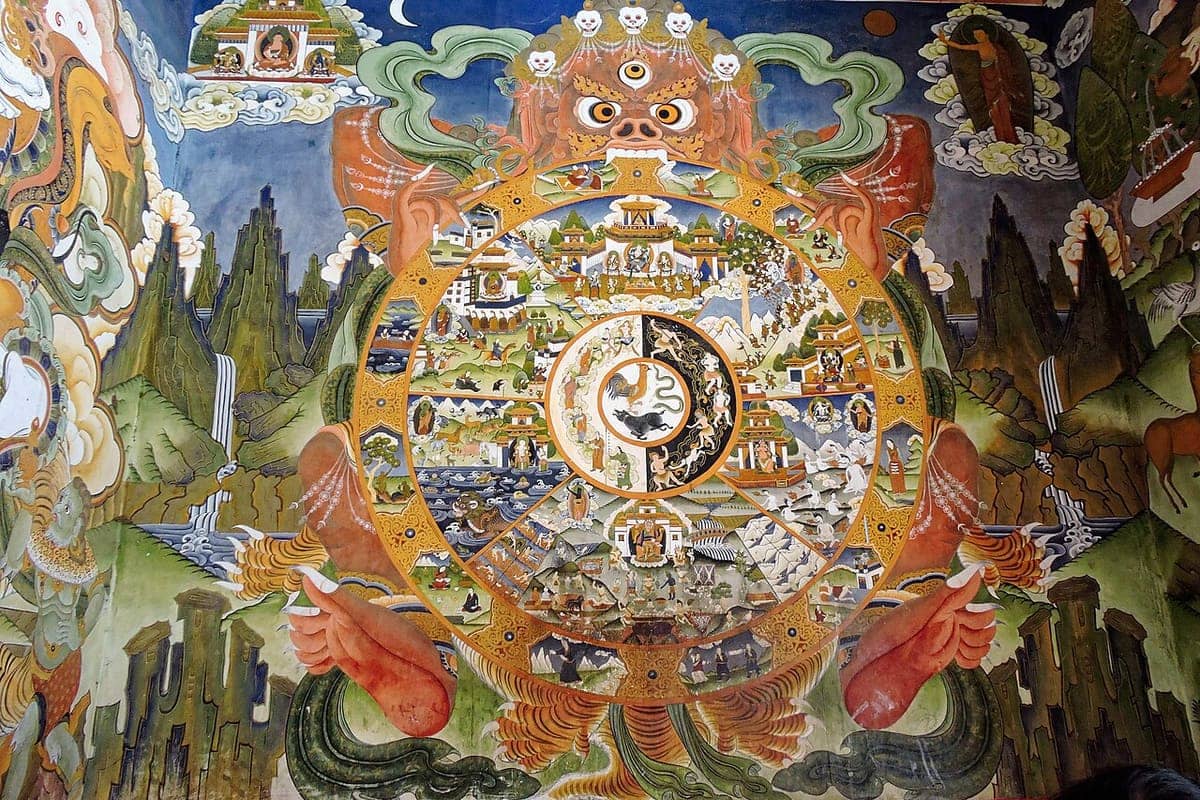
Rebirth and Reincarnation: What Comes Back?
Of all the answers humanity has given to the question of death, this is the one that keeps showing up independently — in India, in Greece, in scattered tribal cultures that never met. Not heaven, not oblivion, but return. You die, and you come back. It is one of the oldest and most widespread human intuitions about what happens next. And yet the traditions that hold it most seriously disagree, deeply, about the thing that matters most: whether anything fixed actually survives the crossing — or whether “you” were never a fixed thing to begin with.
Are reincarnation and rebirth the same idea?
In everyday speech the words are interchangeable. In the traditions that built their whole picture of existence around them, they are not — and the difference is the most interesting thing here.
The Hindu picture is the one most Westerners mean by reincarnation: there is an atman, a true self or soul, and it transmigrates. The body falls away and the same self takes up a new one, carrying its karma forward like a traveler changing clothes. The Bhagavad Gita says it almost exactly that way — “As a person sheds worn-out garments and puts on others that are new, so the embodied self casts off worn-out bodies and enters into others that are new” (Bhagavad Gita 2:22, Library →). Something endures. The vehicle changes; the traveler does not.
Buddhism keeps the return and removes the traveler. This is rebirth, and its signature move is anatta — no fixed self. There is no soul-substance handed from one life to the next. What continues is more like a flame passed from one candle to another: the second flame is not the first flame, yet it is not unconnected to it either. Causes and conditions — including karma — carry over; an unchanging “you” does not. The Dhammapada turns the whole drama inward, treating the chain of becoming as something to see through rather than ride (Library →). It is a stranger and subtler idea than reincarnation, and it is easy to miss how radical it is: rebirth without anyone who is reborn.
Why do so many separate cultures land on return?
Set the metaphysics aside and look at the spread. The intuition that life cycles rather than ends is not a regional quirk — it surfaces, independently, across the ancient world.
Jainism, India’s other great rebirth tradition, makes the soul (jiva) almost physical: every action literally weighs it down with karmic matter, and the entire spiritual path is about burning that weight off so the soul can finally rise, light, and free. The Jains took karma more literally than anyone, and built one of history’s most rigorous ethics of non-harm out of it.
Then cross to Greece, which had no contact with India and arrived in the same neighborhood anyway. The Orphic mystery cults and the Pythagoreans taught metempsychosis — the soul falling into body after body, the body as a kind of tomb it must escape. Plato carried the idea into philosophy: in the Republic, the myth of Er describes souls choosing their next lives before drinking from the river of forgetting and being born again. The same shape — a soul, a wheel, a forgetting, a return — appears in two civilizations that had no way to copy each other’s homework. That convergence is not proof of anything. But it is data, and it is hard to wave away as a single culture’s wishful thinking.
What does the modern reincarnation-memory research actually show?
Here the ground gets careful, and it is worth being honest about exactly what exists and what doesn’t.
Beginning in the 1960s, the psychiatrist Ian Stevenson at the University of Virginia spent decades documenting young children — usually between two and five — who spontaneously described detailed memories of a previous life: names, places, manners of death, sometimes birthmarks corresponding to wounds on a deceased person they claimed to have been. His successor, Jim Tucker, continues this work at the UVA Division of Perceptual Studies today, with a database of well over two thousand cases.
What these are, precisely, is reports — carefully collected, often cross-checked against records, occasionally hard to explain by ordinary means. What they are not is proof, and the researchers themselves are the first to say so. The cases cluster heavily in cultures that already believe in rebirth, which cuts more than one way. Some hold up to scrutiny better than others. Existential Atlas’s position is the honest one: this is a body of unusually careful testimony, not a verdict. It belongs on the table. It does not close the question.
Where does the near-death pattern fit in?
The strongest firsthand testimony we have about the threshold doesn’t usually arrive carrying a doctrine. It arrives carrying a pattern — and the pattern speaks to rebirth in its own way.
People who clinically died and returned, across every faith and none, describe a few things with striking consistency: awareness continuing after the body stopped, often clearer than waking life; a light experienced as conscious and loving; a panoramic review of their life felt from the inside of everyone they had affected; and, almost universally, the loss of their fear of death. (Watch a firsthand account of the life review → (Ishtar Howell))
That life review is the detail that rhymes with the rebirth traditions most precisely. It is karma, experienced rather than theorized — every action met again from the receiving end, nothing weighed by an external judge, the accounting somehow built into the act itself. The Hindu and Buddhist insistence that consequence carries forward, the Jain image of action leaving a residue on the soul, the Greek wheel of forgetting and return — and then thousands of modern people, who read none of that, describing the same self-administered reckoning at the edge of death. Independent witnesses converging on one structure. Existential Atlas won’t tell you what it proves. It will only point out how loud the convergence is, and leave the conclusion where it belongs.
What we actually know
No tradition has produced proof that anyone comes back, and none has disproved it either. What we have is a pattern of unusual persistence: the same basic shape — a self or a stream of consciousness carrying its consequences forward into a new life — arising independently in India, Greece, and beyond; a body of carefully documented modern cases that are easier to record than to explain; and the near-death accounts, which keep describing a reckoning that looks a great deal like karma seen from the inside.
The deepest disagreement isn’t even whether we return. It is who does — a soul that keeps its identity, or a process with no fixed center at all. The brain may yet account for some of this; that explanation is real, and it is not the whole picture, and it does not get the last word here. The pattern is real. The pattern is strong. What it means is the one thing no one can hand you — and that question is yours.
Existential Atlas lays these perspectives out with the original sources side by side. What happens when you die? → · or explore the question yourself.
Frequently asked questions
What is the difference between reincarnation and rebirth? Reincarnation (the Hindu picture) holds that a fixed self, the atman, transmigrates intact from body to body. Buddhist rebirth keeps the continuity of cause and karma but denies any fixed self — what continues is a stream, like a flame passed between candles, not a soul. The Buddhist afterlife →
Is there evidence for reincarnation? There is testimony, not proof. The University of Virginia has documented over two thousand cases of young children reporting detailed past-life memories, some hard to explain by ordinary means. The researchers themselves treat these as reports, not verdicts. Does consciousness survive death? →
Do near-death experiences support reincarnation? Not directly — most NDEs don’t arrive with a doctrine. But the life review they describe, where every action is met again from the receiving end, closely mirrors the idea of karma carrying forward that underlies rebirth. Near-death experiences →
Is karma real? No tradition can prove it, but the idea that consequence carries forward appears across Hindu, Buddhist, and Jain thought — and reappears, uncoached, in the self-administered life review of near-death accounts. Is there karma? →