What Is Samsara?
Most people meet the word as a synonym for reincarnation — you die, you come back, repeat. That’s a thin translation of a much bigger idea. Samsara (Sanskrit for “wandering” or “flowing on”) names not the mechanism of rebirth but the whole predicament: the beginningless, repeating round of birth, craving, aging, death, and re-birth that the Indian traditions say we are caught in — and the diagnosis of why we’re caught. It’s less “do we come back” and more “we are on a wheel, and the wheel is the problem.” Once you see it that way, you start noticing the same wheel described far beyond India. (For how rebirth is thought to work, see rebirth & reincarnation; this page is about the cycle itself.)
What samsara actually is
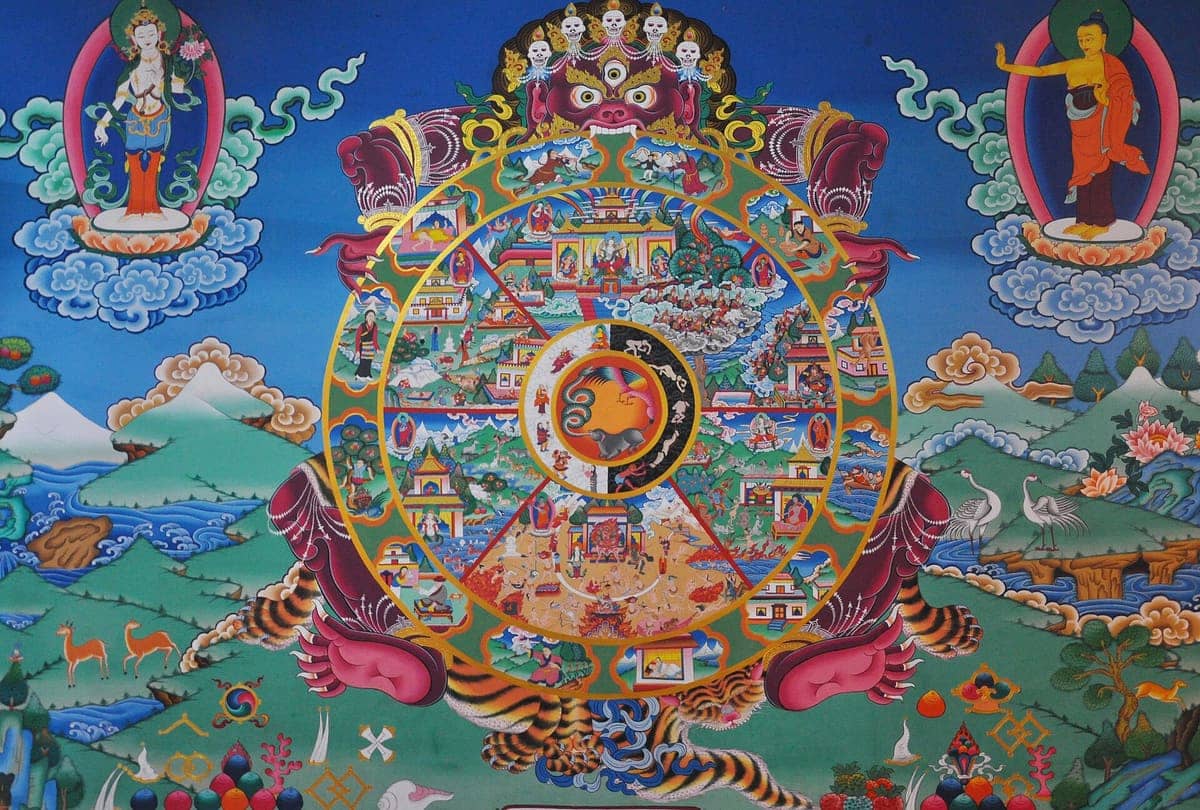
Picture the Tibetan bhavachakra — the “wheel of life” gripped in the jaws of a demon. It’s the most exact image of samsara there is: a wheel turned by three animals at the hub — a pig, a snake, and a rooster, standing for ignorance, aversion, and craving — the forces that keep it spinning. Around the rim are the realms a being cycles through, and the whole thing is held by Yama, lord of death, because nothing inside it escapes dying.
The teaching behind the picture is precise. Bound existence is driven by karma — action and consequence — and fueled by tanha, thirst: the endless wanting that, each time it’s satisfied, simply reasserts itself. Buddhism marks all of this conditioned existence with three characteristics: it is impermanent (anicca), unsatisfactory (dukkha), and without a fixed self (anatta). That’s the crux. Samsara isn’t called a problem because rebirth is frightening; it’s called a problem because the whole cycle, even at its most pleasant, never fully satisfies — it always turns again. The Dhammapada frames the entire spiritual task as getting off this wheel (Dhammapada, ch. 1). Hinduism describes the same bondage and points to moksha, release, as the soul’s true aim; the Bhagavad Gita likens changing bodies to changing worn-out clothes (Bhagavad Gita 2:22) — a process that continues until liberation. The way out, in both, is to extinguish the craving and ignorance at the hub: nirvana / moksha.
One wheel, many traditions
Here’s why samsara belongs on a map of patterns rather than a single faith. The idea that existence is a binding cycle you’re meant to be freed from shows up, independently, across the world.
It is shared across the Indian traditions — Hinduism, Buddhism, Jainism, and Sikhism all teach samsara and a release from it, differing on the details of self and liberation. But it’s not only Indian. The ancient Greeks had it: the Orphics and Pythagoreans spoke of the “wheel of birth,” and Plato has souls cycling through lives in the myth of Er. Kabbalistic Judaism has gilgul, the soul’s rounds of return. And stripped of metaphysics, the bare structure is recognizable to anyone: the hedonic treadmill that modern psychology describes — desire, brief satisfaction, renewed desire — is samsara’s hub drawn in secular ink. Traditions that never met kept noticing the same thing: that ordinary life has a circular, self-renewing quality, and that wisdom might mean stepping off the circle rather than running it faster.
Why the idea endures
Even if you grant samsara no afterlife at all, it survives as a description of something true about a single lifetime. The pattern of want → get → habituate → want again is one most people can verify by Tuesday afternoon. That’s the genius of the diagnosis: before it’s a claim about rebirth, it’s a claim about the mechanics of dissatisfaction — that chasing the next thing is itself the trap, not the solution to it. The traditions that take samsara furthest simply extend that loop across lifetimes and ask the obvious next question: is there a way out of the wanting, not just a better position within it? Their answer — karma governs the wheel, and liberation ends it — is the part you can take or leave. The description of the wheel is harder to argue with.
What we actually know
What can be said plainly: samsara is not a synonym for reincarnation but a whole picture of existence as a self-renewing cycle of craving and consequence — and the picture is shared, in recognizable form, by the Indian religions, the ancient Greeks, Kabbalah, and, in secular dress, modern psychology. Whether the cycle literally extends across lifetimes is exactly the unprovable part; no one can demonstrate the wheel keeps turning after death. But the convergence is real, and it cuts in two directions worth holding at once: most of the world’s contemplative traditions, working separately, concluded that ordinary life is a loop — and that the deepest freedom lies in stepping off it rather than winning another lap. What that’s worth is yours to weigh.
Existential Atlas maps these perspectives with the original sources side by side. What is nirvana? → · or explore the question yourself.
Frequently asked questions
What does samsara mean? It’s the Sanskrit word for the beginningless cycle of birth, death, and rebirth — but more deeply, the whole condition of bound, craving-driven existence that the Indian traditions say we’re caught in until liberation. Not just “you come back,” but “we’re on a wheel, and the wheel is the problem.” How rebirth & reincarnation work →
What causes samsara? In Buddhist and Hindu thought, the wheel is turned by ignorance, craving, and aversion, and propelled by karma — action and its consequences. The thirst that’s never satisfied keeps the cycle spinning. Is there karma? →
How do you escape samsara? By extinguishing the craving and ignorance at its hub — the liberation the traditions call nirvana (Buddhism) or moksha (Hinduism). It’s framed as awakening from the cycle rather than improving your position within it. What is nirvana? →
Is samsara the same as reincarnation? Related but not identical. Reincarnation is the mechanism — a self or stream of consciousness taking new bodies. Samsara is the whole predicament — the entire conditioned cycle of craving, suffering, and rebirth, framed as something to be freed from. How rebirth & reincarnation work →