What Do Buddhists Believe Happens After Death?
Most traditions that expect something after death imagine a soul that survives it — a fixed inner self that leaves the body and goes somewhere. Buddhism gives a stranger and more precise answer: there is no such permanent self to begin with, and yet something continues anyway. Holding both halves of that at once is the whole of the Buddhist view, and it is worth slowing down for.
Rebirth, not reincarnation
The distinction matters. Reincarnation usually means a soul moving from one body to the next, the way you might change houses. Buddhism teaches rebirth — and there is no soul making the trip. The teaching of anatta, or non-self, holds that what you call “you” is not a single unchanging thing but a process: a stream of awareness, perception, and habit, remade moment to moment.
The classic image is a flame passing from one candle to another. The second flame is not the first — and it is not entirely different either. It is conditioned by what came before. At death, the same is said to happen: the momentum of a life — its actions, its cravings, its character — conditions a new becoming, without any fixed soul carrying across. Continuity without a passenger.
Karma and the wheel of becoming
What shapes that continuity is karma — not cosmic reward and punishment, but the simple law that actions have consequences that ripple beyond a single life. The quality of a life inclines the quality of what comes next, across the realms of samsara, the cycle of birth and death the unawakened keep turning through.
This is the part people often miss: in Buddhism, continued rebirth is not the happy ending. It is the problem. The cycle is marked by impermanence and dissatisfaction, and the real aim is not a better next life but release from the wheel altogether — nirvana, the “blowing out” of the craving that keeps it spinning. Liberation is not going somewhere. It is waking up from the loop.
The moment of death, and the clear light
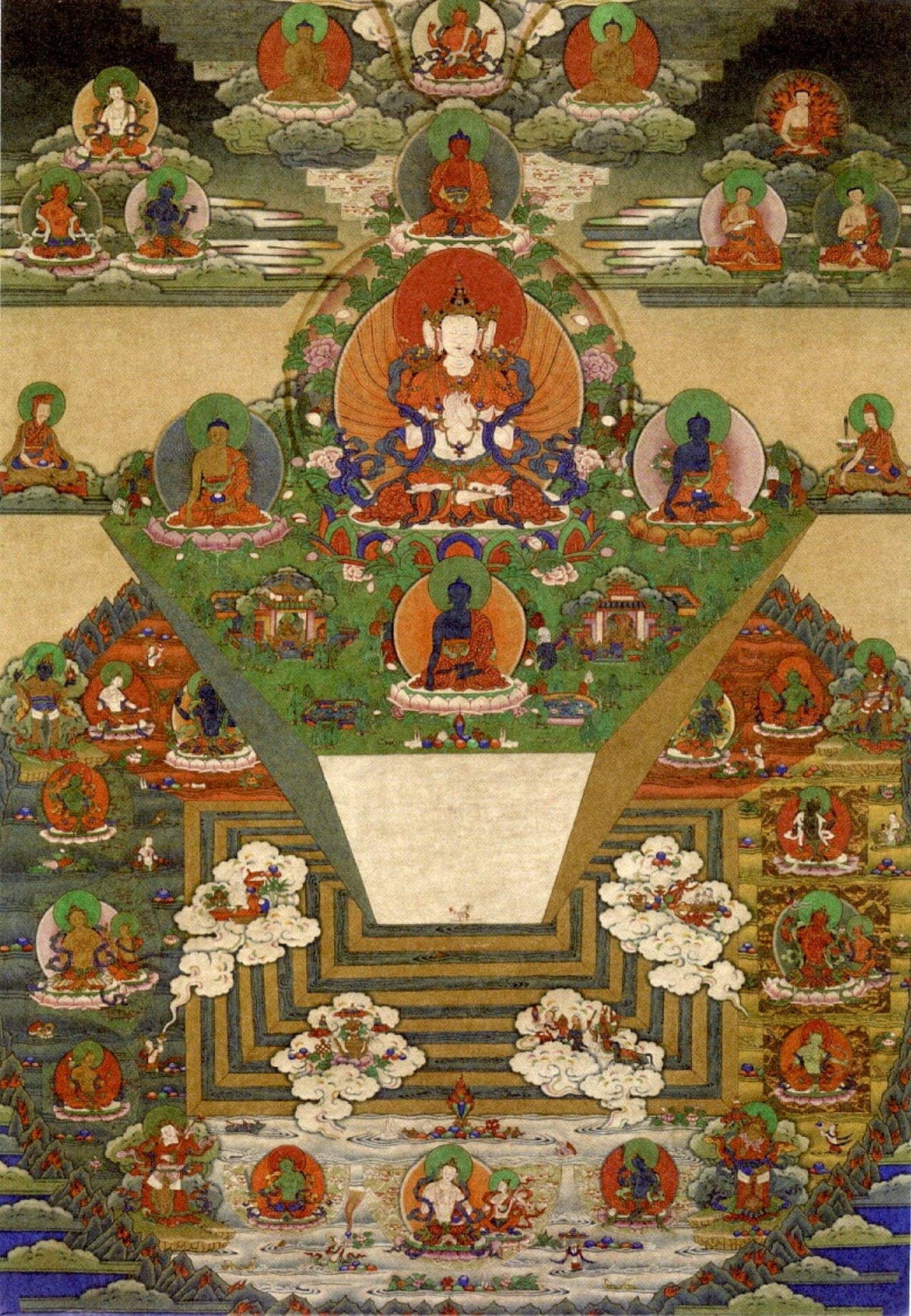
The Tibetan tradition mapped the crossing in unusual detail. In the teachings behind the Bardo Thodol — the so-called Tibetan Book of the Dead — death opens onto the bardo, an in-between state, and at its threshold the dying are said to encounter the clear light: the luminous, undivided nature of mind itself, laid bare when the body falls away. To recognize that light as your own mind is liberation. To recoil from it in fear is to be drawn onward toward another birth.
It is hard to read the modern near-death accounts and not notice the rhyme. People who clinically died and returned describe, again and again, a light experienced not as mere brightness but as aware — vast, loving, and somehow familiar, like something they already were. They are not Buddhist accounts and make no claim to be. But the overlap between a 21st-century cardiac patient and a centuries-old Tibetan text — a radiant, conscious clarity met at the edge of death — is the kind of pattern that recurs across traditions that never touched. Existential Atlas does not tell you what it means. It only shows you that it keeps appearing. (Watch a firsthand account of the light → — NDE in a Timeless Realm)
How this fits the bigger picture
Buddhism’s answer sits inside a pattern shared far beyond it. Nearly every tradition resists the idea that death is simply the end — but they divide on what continues. Where Christianity and Islam describe a person restored, and the Gita describes a self that changes bodies like clothes, Buddhism describes continuity with no fixed self at all. Different maps of the same uncharted country.
See how every tradition — and the near-death accounts — answer the larger question, side by side: What happens when you die? → Or explore it yourself in Existential Atlas.
Frequently asked questions
Do Buddhists believe in reincarnation? Not in the usual sense. Buddhism teaches rebirth without a permanent soul: the momentum of one life conditions the next, like one flame lighting another, but no fixed self makes the journey. What happens when you die? →
What is the goal if rebirth just keeps going? Release from the cycle. Continued rebirth in samsara is the predicament, not the reward; the aim is nirvana — the end of the craving that keeps the wheel turning. Explore further →
What is the clear light in Tibetan Buddhism? The luminous nature of mind said to be revealed at the moment of death. Recognizing it is liberation. Its description echoes the “aware light” reported in many near-death accounts. Near-death experiences →