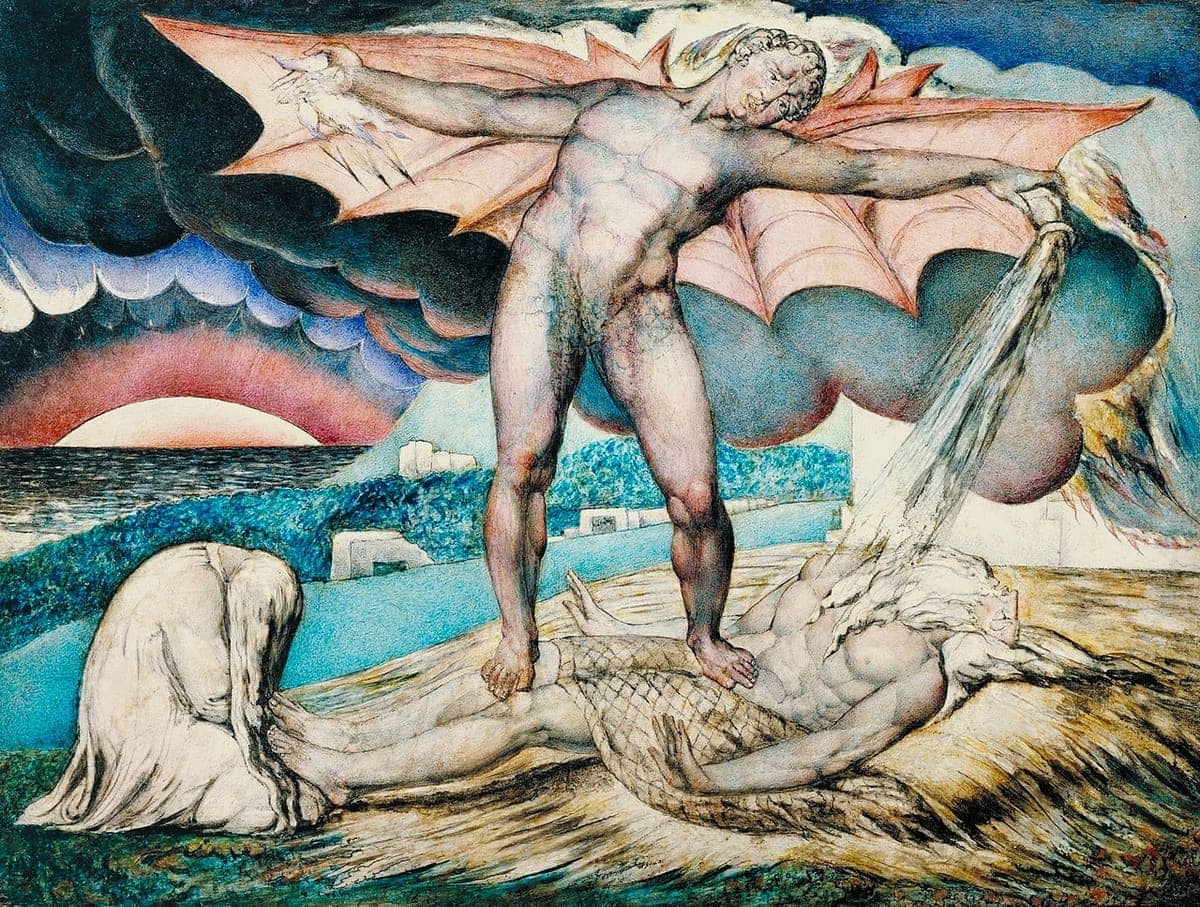
Why Do Bad Things Happen to Good People?
It is the question that has broken more faith than any argument ever could. A child gets sick. A kind person is destroyed by something they did nothing to deserve, while the cruel seem to prosper untouched. And the universe, which we badly want to be fair, says nothing. Every tradition humanity has built has had to stand at the edge of this, and almost none of them have agreed on an answer. But set the disagreements aside for a moment — stop asking which tradition is right — and something stranger comes into view. Across civilizations that never met, the same handful of responses keep surfacing. What follows is not a solution. It is the shape of the oldest objection we have, drawn as honestly as the sources allow.
Is there an answer at all, or only the question?
Start with the tradition that refused to tidy it up. The Book of Job is the oldest sustained treatment of innocent suffering in the Western canon, and its boldness is that it never resolves. Job is righteous, and he is ruined anyway — children, health, wealth, all of it stripped away on a wager he never knew was made. His friends arrive with the era’s standard theology: you must have sinned; suffering is punishment; the books always balance. Job, knowing he is blameless, calls this what it is — a comfortable lie (Job 13:4–5). He demands an explanation directly from God.
And here is the strange thing. When God finally answers out of the whirlwind, he gives Job no explanation at all. Instead he asks where Job was when the foundations of the earth were laid (Job 38:4) — a torrent of questions about a creation too vast for a human mind to audit. The answer to “why do the innocent suffer” turns out to be: you are not in a position to understand the answer. It is one of the most honest moves in all of scripture, and one of the least satisfying. Job is not given a reason. He is given a perspective, and it is enough to quiet him. Ecclesiastes presses the same refusal further still — the same fate, the writer notes coldly, comes to the righteous and the wicked alike (Ecclesiastes 9:2). Some of the deepest religious thinking on suffering begins by admitting there is no clean accounting to be had.
Is suffering built into existence itself?
Where the Hebrew scriptures sit with the mystery, the Buddhist traditions take it apart. The Buddha’s first noble truth is not a complaint but a diagnosis: dukkha — usually translated “suffering,” but closer to a pervasive unsatisfactoriness — is woven into ordinary existence (Dhammapada). Birth, sickness, age, loss, the simple ache of wanting things to be other than they are: this is the texture of being alive, not a malfunction in it.
That reframes the question entirely. The point is not why does a just universe permit suffering — the universe was never advertised as fair. The point is what causes suffering, and can it end? The second noble truth names the cause: craving, the grasping after what cannot last. And because the cause is internal, so is the remedy. This is a profoundly different answer from Job’s. It does not appeal to a hidden divine plan; it locates the lever inside the sufferer’s own relationship to impermanence. Whether suffering is deserved becomes almost beside the point. The Stoics, oceans away, landed somewhere adjacent: it is not events that harm us, Epictetus taught, but our judgments about events — and Marcus Aurelius reminded himself each morning that the obstacle is often the path itself (Meditations). Two traditions, no contact, both turning the question from why me toward what, in this, is actually mine to carry.
Do the books balance across lifetimes?
There is a third answer, and it is the one most of the world’s population has actually held: the suffering only looks undeserved because we are reading a single page of a much longer book. The Hindu and Buddhist logic of karma across lives proposes that the ledger does balance — just not within one lifetime. The good person suffering now is meeting a consequence set in motion before, and the cruelty that goes unpunished today will not stay unpunished forever. The Bhagavad Gita frames death itself as a costume change, the self moving from a worn body to a new one (Bhagavad Gita 2:22), which means the moral accounting has room to run far beyond what any one life can show.
It is worth naming plainly what this does. Karma answers the fairness objection completely — nothing is undeserved, because the timeline is long enough to settle every debt. That is its power and, for many, its difficulty: pushed hard, it can seem to blame the sufferer for a past they cannot remember. The monotheistic traditions reach for a related move without the rebirth: the scales are real but they are settled after this life, not within it. The Qur’an returns again and again to a final reckoning where no wrong is overlooked and no atom of good is lost (Qur’an 99:7–8). The shared instinct underneath all of it is the same one that powers the whole question: a refusal to believe that the moral order simply doesn’t add up. If it doesn’t balance here, the intuition runs, it must balance somewhere.
What if the price of love is the possibility of harm?
There is a fourth answer that doesn’t appeal to a longer timeline at all, and it is the one philosophers keep returning to: the free-will defense. Much of the worst suffering — the cruelty, the betrayal, the harm people do to one another — is the cost of a world in which beings are genuinely free. A universe engineered so that no one could ever be hurt would also be a universe in which no one could ever truly choose, love, or matter. Goodness that cannot be refused, the argument goes, is not goodness; it is a script. The capacity that makes a person able to love is the same capacity that makes them able to wound.
This does not touch the harder cases — the earthquake, the cancer, the suffering no human chose to inflict — and honest theology has never pretended it does. But it reframes a large share of human cruelty not as evidence that the universe is broken, but as the shadow side of the very freedom that gives life its weight. The traditions that lean on this tend to pair it with something the next section makes strange: a sense, reported by people who say they have seen further, that even the suffering we did not choose was somehow not wasted.
Did the suffering mean something? What the near-death accounts report
Here the question takes a turn that the philosophy alone cannot follow. Among the most consistently reported features of a near-death experience is the life review — a panoramic, instantaneous replay of one’s life, often re-lived not from one’s own point of view but from the perspective of the people one affected. Experiencers describe feeling the grief they caused as the other person felt it, and the kindness they gave as it landed on its recipient. No one is condemning them. They are simply, finally, seeing.
What is striking, for this question specifically, is what so many of them say about their own suffering. Again and again, people return from these experiences reporting a sense that the hardest things that happened to them were not random — that the pain had carried meaning, even served as a kind of teaching, in a way they could feel directly during the review even when they could not put it into words afterward. Some come back describing earthly life as a place built precisely for that growth, the difficulty not a bug but the curriculum. This is not offered here as doctrine. It is offered as data: it is one of the most frequently reported aftereffects in the entire near-death literature, described by people of every faith and of none, most of whom had never read a word about it beforehand. (Watch a firsthand account of the life review → (Ishtar Howell))
And the parallel to the old texts is hard to miss. The Egyptian Book of the Dead pictured the heart weighed against the feather of truth while the dead person watched (Book of the Dead, Spell 125) — a life seen whole and measured. The near-death accounts describe the same panoramic seeing, but with the judgment removed and something gentler in its place: the sense that the suffering, too, was part of what the life was for. Tens of thousands of these accounts are now catalogued by the Near-Death Experience Research Foundation and the University of Virginia’s Division of Perceptual Studies. They do not agree on theology. They agree, with remarkable consistency, that the pain was not meaningless. That an ancient scribe and a modern cardiac patient reach for the same image is the kind of overlap that is very hard to look away from. We will not tell you what it means. We will only say the pattern is real, it is old, and it keeps repeating.
What we actually know
Honestly: no tradition has produced proof, and none of these accounts can be handed across to someone who did not live them. Job is told the answer is beyond him. Buddhism relocates the problem inside the self. Karma and the final reckoning extend the ledger past death. The free-will defense accepts that love and harm are bought with the same coin. And the near-death accounts report — without being able to demonstrate it — that the suffering meant something. Each of these answers something the others leave open, and none of them closes the case. Anyone who tells you the question is settled, in either direction, is selling something.
But the patterns are real, and they are not small. The refusal to believe the moral order simply doesn’t add up. The instinct that what doesn’t balance here balances somewhere. The recurring report, across traditions that had no contact and across thousands of modern accounts from people who clinically died and returned, that the pain was not wasted. These themes keep surfacing — the closest thing we have to a shared human reading of suffering from more than one angle.
What that recurrence means is the one question no one can answer for you. That is not a failure of the material. It is the most honest thing that can be said about it — and it is exactly the place where your own thinking begins.
Existential Atlas maps these perspectives with the original sources side by side — scripture, philosophy, and the indexed accounts of people who died and came back. Explore the question yourself →
Frequently asked questions
Why do we suffer? Traditions answer in very different registers — Buddhism roots suffering in craving and impermanence, Christianity and Islam point toward a reckoning that sets the books right beyond this life, and Stoicism locates the leverage in our own judgments about events. The recurring instinct underneath all of them is that the pain is not simply meaningless. Read more →
Is life fair? No tradition claims life is fair within a single lifetime — Job and Ecclesiastes say so bluntly. What many of them claim instead is that the accounting runs longer than one life, whether through karma across rebirths or a final reckoning after death. Whether that satisfies you is left to you. Read more →
Is there karma? Karma is the proposal that the moral ledger balances across lifetimes, not within one — that nothing is finally undeserved because the timeline is long enough to settle every debt. It is the answer most of the world’s population has held, and its strength and its difficulty are the same: it leaves nothing to chance. Read more →
What is the problem of evil? It is the oldest objection in philosophy: if a just and powerful order governs the universe, why does it permit the innocent to suffer? The free-will defense, the longer karmic timeline, and Job’s refusal of a tidy answer are three of humanity’s most enduring responses. Read more →