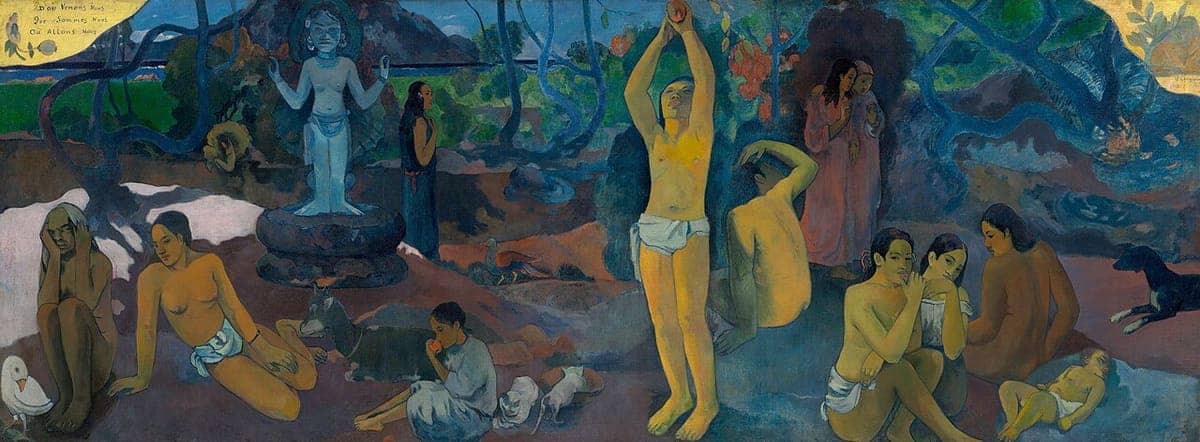
Why Am I Here?
There’s a version of this question that’s about the universe, and a version that’s about you — and they are not the same question. “Why is there something rather than nothing” is for the philosophers. “Why am I here, specifically, this one life, mine” is the one that wakes you at three in the morning. It is personal, almost embarrassingly so, and no amount of cosmology answers it. What follows isn’t a single answer either. It’s a map of the ones humanity keeps arriving at — from the faiths that say you were meant, to the philosophers who say you make your own reason, to the people who clinically died and came back saying they were shown what they came here to do.
Were you sent here on purpose?
Start with the oldest answer, and the most comforting one: you are not an accident. Something intended you.
The religious traditions hold this almost without exception. In the Hebrew and Christian scriptures, a person is not a cosmic afterthought but an image of the divine, formed deliberately and known before birth — “Before I formed thee in the belly I knew thee” (Jeremiah 1:5). The Qur’an frames existence itself as purposeful, never idle or random (Qur’an 51:56). The Bhagavad Gita gives the idea a sharper edge: you arrived with a particular work to do — your dharma — and it is better to walk your own path imperfectly than to live someone else’s flawlessly (Bhagavad Gita 3:35).
Notice what these have in common underneath their different gods. They all say the why of your being here is not something you have to invent against the void. It was already there before you arrived. The task isn’t to manufacture a purpose; it’s to discover the one you were sent with — to find your calling and align yourself with it.
What if you have to make the reason yourself?
The modern existentialists pulled that floor out and asked what’s left if no one sent you.
Jean-Paul Sartre’s answer was stark and, oddly, liberating: existence precedes essence. You show up first, with no fixed nature and no instructions, and you become someone by what you choose. There is no pre-written reason you’re here — which means you are condemned to be free, handed the full weight and dignity of authoring your own purpose. Friedrich Nietzsche said something adjacent: the highest human act is to give your own life a meaning, to become the artist of your own values rather than inherit them secondhand (Thus Spake Zarathustra). And Albert Camus, staring at a universe that returns no answer to our demand for one, refused both despair and false comfort — you live fully anyway, and that defiance is itself the point.
Here’s what’s easy to miss: even the thinkers who deny you were sent with a purpose almost never conclude you have none. They conclude it must be made. That refusal — the near-universal insistence that a human life is not pointless, whether the point comes from above or from within — is itself one of the most consistent things people have ever believed.
Are you here to learn something?
Between “you were sent” and “you invent it” sits a third answer, quieter and more practical: you are here to become something you weren’t yet. Here to grow.
It runs through the philosophers as much as the faiths. Aristotle thought a human life has a function the way an eye or a flame does, and that you are here to fulfill it — to flourish, to bring a soul into its full activity over a lifetime (Nicomachean Ethics). The Stoics narrowed it: you are here to practice virtue, to meet whatever comes with justice and courage, because how you respond is the one thing fully yours (Meditations). The Eastern traditions frame the whole arc of lives as a school — each existence a chance to learn what the last one couldn’t, until the lesson finally takes (Dhammapada). Different vocabularies, one shape: that being here is an education, and you are both the student and the thing being made.
This is the idea that the near-death accounts return to most insistently — and they return to it from outside any tradition at all.
What do the people who nearly died say they came for?
There’s one more body of testimony, and it’s unlike the others, because it doesn’t come from reasoning or revelation. It comes from ordinary people who clinically died, came back, and reported being shown — with a clarity they describe as more real than waking life — what their life had actually been for.
The convergence is the striking part. Across thousands of near-death accounts — catalogued by researchers at the Near-Death Experience Research Foundation and the University of Virginia’s Division of Perceptual Studies — experiencers who shared no religion, and often no belief at all, come back describing the same impression: that they were here on purpose, that earth is something like a classroom, and that they had come to learn how to love. Many describe a life review in which they re-live their own actions from the inside of everyone they affected — feeling the kindness they gave as the other person felt it, and the harm too. And what almost none of them report being measured by is achievement, money, or status. The thing that turns out to have mattered is how they treated people. (Watch a firsthand account → (John’s Extensive Near Death Experience))
Sit with that for a second. People who weren’t reasoning their way anywhere — who expected nothing — return from the edge converging on the answer the traditions argued toward for millennia: that you are here to grow, and that the curriculum is love. They don’t just believe it afterward; they reorder their lives around it. Careers shrink. Relationships grow. The fear of death loosens, and they describe living more vividly, not less. We won’t tell you what that convergence means. We’ll only say it’s there, it’s remarkably consistent, and it keeps repeating in people who had no way to borrow it from each other. You can read more among the near-death experience stories people have shared, and the idea that earth is a school gets its own fuller treatment elsewhere.
What we actually know
Honestly: no one has proven why you’re here. The faiths say you were sent and disagree on by whom. The existentialists say you arrived without instructions and must write your own. The near-death accounts, however consistent, can’t be handed across to someone who didn’t live them. Anyone who tells you the question is closed — in either direction — is selling something.
But the patterns are real, and they aren’t small. The near-universal refusal to call a human life pointless. The recurring sense that being here is a kind of growing-up, an education you’re in the middle of. And the strange convergence — from ancient ethics to people returning from clinical death — on the idea that the thing you came to learn was how to love. Maybe you were sent. Maybe you make the reason yourself. Quite possibly the honest answer is that the why isn’t a fact waiting to be uncovered so much as a thing you’re here to live into. That isn’t a dodge. It happens to be exactly where your own answer begins.
Existential Atlas maps these perspectives with the original sources side by side — scripture, philosophy, and the indexed accounts of people who died and came back. What is your purpose? → · or explore the question yourself.
Frequently asked questions
What is my purpose in life? No tradition has proven a single answer, but they cluster into a few shapes: a purpose you were given by something larger, a function to fulfill through living well, or a meaning you’re free to create. What recurs across nearly all of them is the conviction that the question is worth answering. What is your purpose? →
Is there a reason I exist, or did I make it up? That’s the oldest fault line — given versus made. The faiths say you were intended; the existentialists say you arrive without instructions and author your own reason. Strikingly, even those who deny you were sent rarely conclude you have no purpose at all. The meaning of life, mapped →
Are we here to learn lessons? Many traditions frame life as a kind of school — and it’s the single most consistent theme reported by people who nearly died, who come back describing earth as a classroom for learning how to love. Earth is a school →
Why does asking “why am I here” feel so heavy? Because it’s not abstract — it’s the question of whether your own one life means anything, and that weight is real. Facing it directly, rather than medicating it away, is where most people’s honest answer starts. Existential dread →