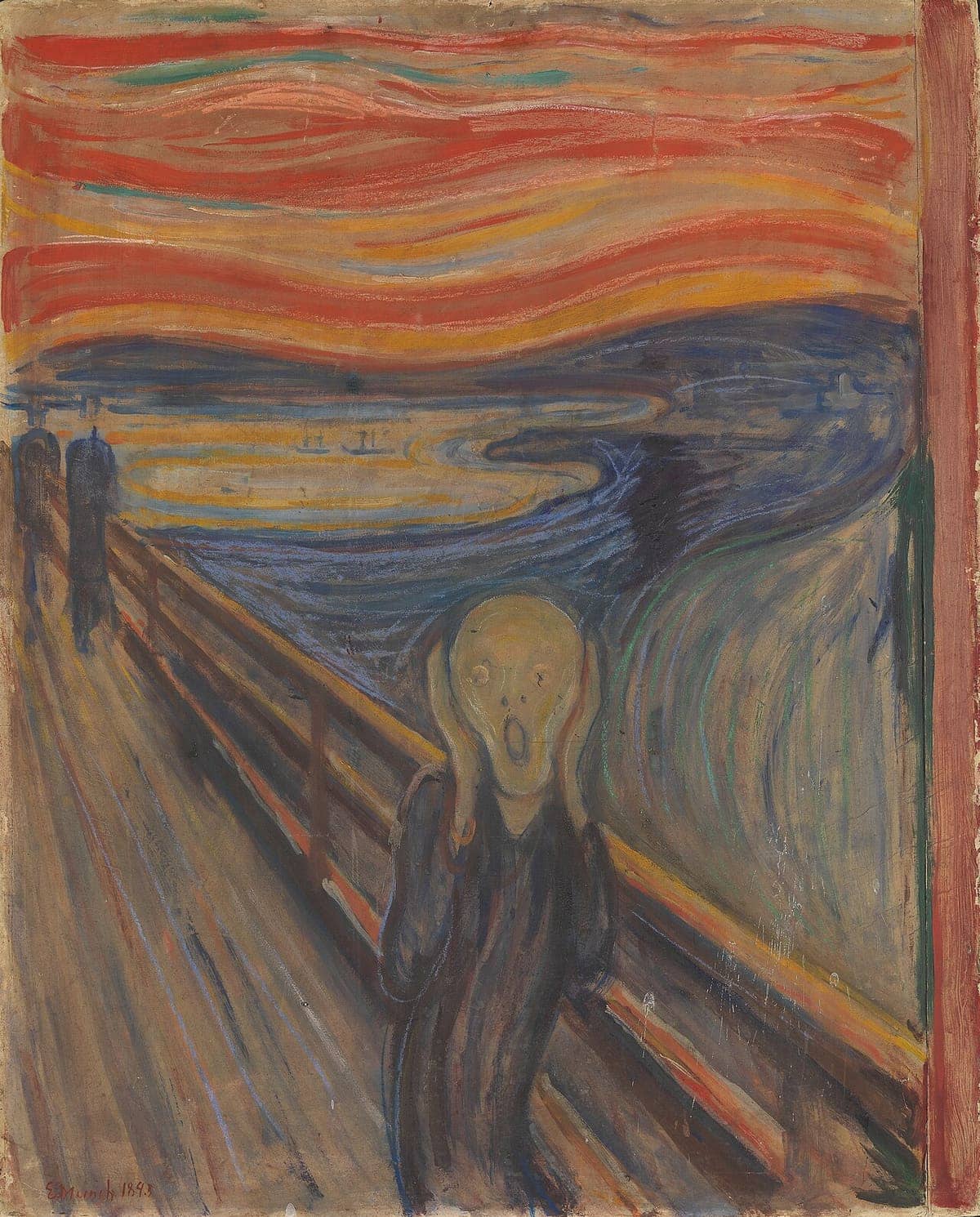
Existential Dread
It usually arrives without warning, and rarely at a convenient time. You’re lying awake at 3 a.m., or driving a familiar road, or watching someone you love sleep — and the floor drops out. The plain fact lands with full weight: you will die, everyone you love will die, and you do not know what, if anything, comes after. That feeling has a name. It’s existential dread, and it is one of the most human things there is. It is not a malfunction. It is what awareness feels like when it turns and looks straight at its own edge. The good news, if there is any, is that you are not the first to feel it — and humanity has spent its entire history answering back.
What is existential dread, really?
Existential dread isn’t ordinary fear. Fear has an object — a deadline, a diagnosis, a dark stairwell. Dread has no object you can point to, which is exactly what makes it so disorienting. It’s the background hum that shows up when the everyday distractions go quiet and the big facts come into view: that you are finite, that meaning is not handed to you, that the universe did not come with instructions.
The philosophers who took this most seriously called it by different names. Kierkegaard called it angest — anxiety — and described it as “the dizziness of freedom,” the vertigo you feel standing at the edge of all the lives you could choose and the death that ends every one of them. Heidegger said this anxiety is actually clarifying: most of the time we live “fallen” into routine and chatter, and only when dread strips that away do we glimpse our lives as genuinely ours, lived toward an end. The dread, in other words, is not the problem. It’s the moment the picture comes into focus.
Why do we feel it at all?
Because we’re the animal that knows. As far as we can tell, you are a creature aware of its own mortality in advance — able to hold, in an ordinary Tuesday, the knowledge that the Tuesdays will run out. That awareness is the engine of nearly everything we’ve built: art, religion, philosophy, the pyramids, the cathedrals, the questions Existential Atlas exists to map. Dread is the shadow that same awareness casts.
This is why the feeling tends to spike at thresholds — a milestone birthday, a death in the family, the quiet after a goal is finally reached. The structures that normally keep the question at bay thin out, and you see the thing they were built to cover. It’s worth saying plainly: feeling this does not mean something is wrong with you. It means something is working in you. The traditions treated this not as a symptom to suppress but as a door to walk through.
How does existentialism meet the dread?
The existentialists refused to look away, and that refusal is itself a kind of answer. If the universe hands you no built-in meaning, Sartre argued, then meaning is not discovered but made — you are “condemned to be free,” responsible for the significance of your own life precisely because nothing external assigns it. That’s a heavier burden than comfort, but it’s also a strange dignity: the meaning of your life is genuinely yours to author.
Camus went further into the discomfort and somehow came out lighter. He named the gap between our hunger for meaning and the silent universe “the absurd,” and refused both escapes — neither suicide nor a leap into easy belief. His image was Sisyphus, condemned to roll a boulder uphill forever, and his startling conclusion: “One must imagine Sisyphus happy.” The dread doesn’t get solved. It gets carried, consciously, even defiantly — and in the carrying, life becomes yours rather than something happening to you. (Read Nietzsche on living without flinching →)
What do Stoicism and Buddhism do with the fear of death?
Long before the existentialists, two older traditions met the same dread head-on — and arrived, from opposite directions, at a strange peace.
The Stoics turned and stared directly at death until it lost its grip. Marcus Aurelius, an emperor with every reason to cling to life, wrote in his private journal that you should “think of yourself as dead. You have lived your life. Now take what’s left and live it properly,” and reminded himself that fear of death is really fear of losing the present moment — which is the only thing anyone ever actually has (Meditations →). The Stoic move is not to deny mortality but to befriend it: memento mori, remember you will die, not as a morbid threat but as the thing that makes today matter.
Buddhism dissolves the dread from another angle entirely. Its diagnosis is that suffering comes from clinging to what cannot last — and that the self we’re so terrified of losing was never the fixed, solid thing we assumed. The Dhammapada teaches that “all conditioned things are impermanent,” and that seeing this clearly is the beginning of freedom rather than despair (Dhammapada →). If you stop bracing against impermanence and let it be the texture of reality, the dread has less to grip. The Tao says it more gently still: the wise person, the Tao Te Ching suggests, moves with the current of arising and passing rather than against it (Tao Te Ching →).
What do the people who actually died tell us about the fear?
Here is where the question stops being abstract. Over the last fifty years, a category of witness has appeared that no previous century had in such numbers: people who were clinically dead — flatlined, no pulse, no measurable brain activity — and came back to describe it.
Their reports vary in the details, but on one point the convergence is almost eerie. Whatever existential dread they carried before, the overwhelming majority lose their fear of death afterward — completely, and permanently. They describe awareness continuing after the body stopped, often clearer than ordinary life; a light experienced as conscious and unconditionally loving; a panoramic review of their life felt from the inside of everyone they’d ever touched; and a sense, hard to put into words, of having returned somewhere they already belonged. (Watch a firsthand account (Shocked Back to Life) →)
That last part is the piece that bears directly on dread. These are not people reasoning their way to calm. They are people who report having been to the edge and come back convinced the edge was not an ending. Thousands of such accounts have now been gathered by researchers at the Near-Death Experience Research Foundation and the University of Virginia’s Division of Perceptual Studies. They had no way to coordinate, came from every faith and from none, and keep describing the same threshold. It does not tell you what death is. It tells you that the people who got closest to it came back less afraid, not more — and that the dread you feel at 3 a.m. may be answering a question that, on the far side, looked different than it does from here.
What we actually know
Honestly? No one can tell you for certain what death is, and so no one can fully dissolve the dread by argument. That’s the true state of things, and pretending otherwise would be its own kind of dishonesty.
But notice what is known. The dread is not a disorder — it’s the price of being awake, the same awareness that lets you love and create and ask. Every serious tradition has met it and refused to flinch: the existentialists by making meaning yours to author, the Stoics by befriending mortality, the Buddhists by loosening the grip on a self that was never as solid as it felt, and the people who clinically died by coming back, almost without exception, unafraid. None of that is proof of anything. The pattern is real all the same — and the meaning you make of it is the one thing no philosopher, no scripture, and no testimony can decide for you. That last freedom is yours.
Existential Atlas maps how every tradition has answered the questions underneath the dread, with the original sources side by side. What is the meaning of life? → · or explore the question yourself.
Frequently asked questions
Is existential dread a mental illness? No. Existential dread is a normal response to genuinely confronting mortality and meaning — philosophers from Kierkegaard to Heidegger treated it as a clarifying feature of being human, not a defect. It can overlap with anxiety, but the feeling itself is the price of awareness, not a diagnosis. Existential crisis →
How do I deal with the fear of death? The traditions don’t offer one cure — they offer several stances. The Stoics befriend death by facing it daily; Buddhism loosens the clinging that makes loss terrifying; the existentialists make meaning yours to author. And the near-death accounts report the fear lifting entirely on the far side. Near-death experiences →
What’s the difference between existential dread and an existential crisis? Dread is the low background hum — the awareness of mortality and meaninglessness that comes and goes. An existential crisis is when that hum becomes a sustained reckoning that destabilizes how you’ve been living. One is a feeling; the other is a turning point. Existential crisis →
Does anything actually come after death? No one can prove what comes after — but the near-death accounts are remarkably consistent, and the people who got closest to death came back convinced it wasn’t an ending. What that adds up to is the question only you can answer. Is there life after death? →