Where Do You Go When You Die?
“Where” is a strange word to use about death, and every tradition knows it — wherever you go, it is not a place you could point to on a map. And yet the question won’t leave us alone, and the answers humanity has given fall into a few recognizable destinations. Here they are, side by side, without any one being named the true one.
To paradise — or to judgment
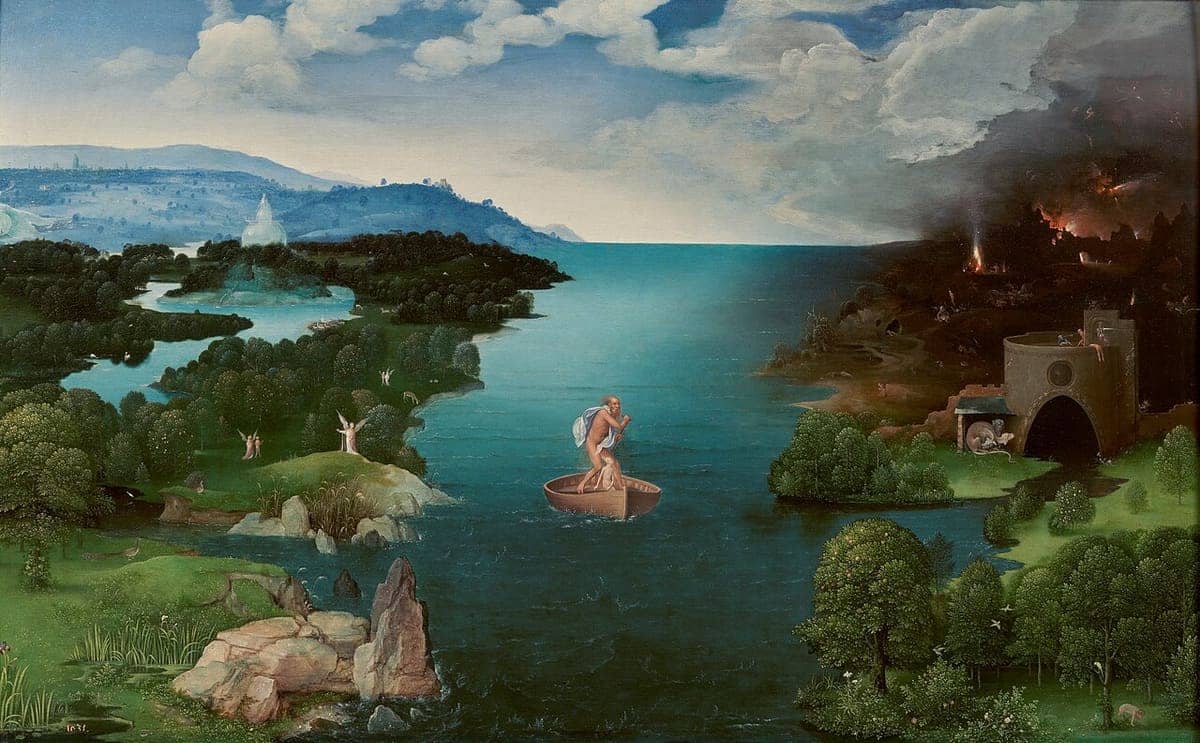
The most familiar answer in the West is a place of reward or reckoning. In the Christian picture, the faithful are received into the presence of God — Jesus tells the man dying beside him, “To day shalt thou be with me in paradise” (Luke 23:43) — with a final resurrection and judgment still to come. Islam describes the soul entering barzakh, an interval that awaits the Day of Resurrection (Qur’an 23:99–100). Ancient Egypt sent the soul through a perilous afterworld to be weighed against the feather of truth before passing on (Book of the Dead, Spell 125). What these share is a sense that where you go is bound up with how you lived.
Back into a new life
A second answer says you do not go “somewhere” at all — you come back. In the Hindu and Buddhist traditions, death opens onto rebirth: the momentum of a life conditions the next, turning the wheel of samsara until it is finally transcended (Bhagavad Gita 2:22). Tibetan Buddhism maps the in-between in unusual detail — the bardo, a transitional state between death and the next birth, where what you meet depends on what you are able to recognize. The destination here is not a heaven but another beginning.
Back to the source
A quieter answer holds that you return to where you came from before there was a “you” at all. Taoism speaks of returning to the root from which all things briefly arise (Tao Te Ching 16). The Stoics expected no personal destination and made peace with it — death simply returns the borrowed self to nature. Here “where do you go” dissolves into “what you were is given back.”
The “place” near-death experiencers describe
And then there are the people who say they went somewhere and came back. Their accounts are not a theology, but they are remarkably consistent: a passage, often through dark to light; a realm experienced as more real than ordinary life; a presence of light felt as conscious and loving; and frequently a reunion with people already gone. Almost all of them report a boundary they understood they could not cross and return — and a deep reluctance to come back at all. (Watch a firsthand account → (NDE in a Timeless Realm)) That so many unconnected people reach for the same images is a pattern worth seeing clearly, whatever one concludes it means.
So where do you go?
No tradition can prove its map, and the people who report having seen something cannot hand it across to those who haven’t. What can be said is that the destinations humanity imagines are few and recurring — a place of reckoning, a new life, a return to the source — and that the firsthand accounts from the edge keep describing the same light, the same boundary, the same sense of homecoming. The pattern is real. Where it actually leads is the one question you have to answer yourself.
Existential Atlas maps these views with the original sources side by side. What happens when you die? → · Is there life after death? → · or explore it yourself.
Frequently asked questions
Where do you go when you die, according to the Bible? The faithful are described as entering God’s presence — “to day shalt thou be with me in paradise” (Luke 23:43) — with a resurrection and final judgment still to come. Christian view →
Do you go to heaven immediately when you die? Traditions differ. Some Christian readings describe being “present with the Lord” at once; others emphasize a sleep or interval until resurrection. Islam describes barzakh, a waiting state. Where the traditions differ →
Where do you go if reincarnation is true? Not to a place but into a new life — the conditioned continuation of consciousness into another birth, until the cycle is transcended. Rebirth and reincarnation →