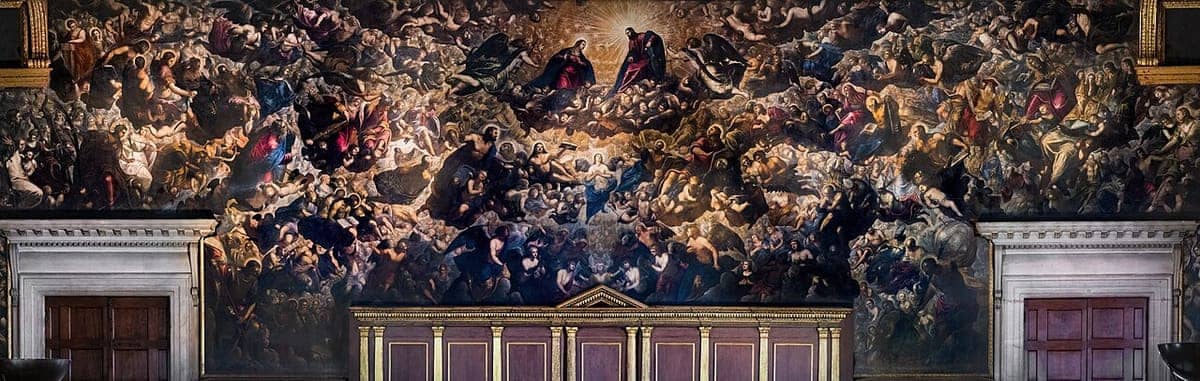
What Does Heaven Look Like?
There are no photographs of heaven, and the people most certain it exists are usually the first to say it can’t really be drawn. But the question is older than any religion and impossible to stop asking — so the honest thing isn’t to refuse it, it’s to lay out how humanity has actually answered it. And when you set the descriptions side by side — the world’s scriptures next to the testimony of people who clinically died and came back — they rhyme in a way that’s hard to ignore: the same light, the same impossible color, the same gardens and city and homecoming. Here’s the picture they keep painting.
What the scriptures picture
The sacred texts don’t agree on much, but their images of paradise overlap to a striking degree.
The Christian picture is the most architectural. Revelation describes a city of gold and jasper, gates of pearl, a “pure river of water of life, clear as crystal” (Revelation 22:1), needing no sun “for the Lamb is the light thereof” (Revelation 21:23) — and, most movingly, a place where “God shall wipe away all tears… and there shall be no more death, neither sorrow, nor crying” (Revelation 21:4).
The Islamic picture is a garden. The Quran returns again and again to Jannah — “gardens beneath which rivers flow” (Quran 2:25) — a paradise of shade, fruit, peace, and nearness to God. Judaism speaks more reservedly of Olam Ha-Ba, the World to Come, and of the soul’s nearness to the divine presence. And the word paradise itself comes from an old Persian term for a walled garden.
Strip the labels and the recurring elements are specific, not vague: light that is more than brightness; water — rivers, a crystal sea; a garden or a city; reunion with those gone before; and above all the end of suffering. Traditions separated by centuries and continents reach for the same handful of images.
What near-death experiencers describe
Here is the part that turns the question from theology into testimony. People who have clinically died and returned describe the place in terms that line up, element for element, with the scriptures — and they had no reason to coordinate.
They begin, almost always, with light — but they correct you: not brightness, a living light, conscious and pouring out love. Past it, a landscape: meadows, gardens, rolling fields, sometimes a city of light, and water turning up again and again. Color the language can’t hold — greens and golds they insist don’t exist here. Often music that seems to come from everything at once. And the feeling that swallows all of it: that they were home, more than they had ever been in life. This convergence appears across thousands of independently gathered accounts, catalogued by researchers at the Near-Death Experience Research Foundation and studied for decades at the University of Virginia’s Division of Perceptual Studies. We collect the fuller set of these descriptions on the pictures of heaven from near-death experiences page. The point worth sitting with: people who never read Revelation come back describing gardens, living water, a city, and impossible light — the exact vocabulary of the scriptures.
Where is heaven — and is it a place at all?
“Where” may be the wrong question. Across the traditions, heaven drifts between being a location and being a state — the conscious presence of God, a dimension of reality rather than a spot in the sky. Many theologians stress that the gold and gardens are imagery for something the mind can’t hold directly, the way you’d describe an overwhelming experience in the nearest available pictures. The near-death accounts say something similar: experiencers insist the place was more real and more dimensional than the physical world, and that any image they give you is a thinning-out of it. So the honest answer to “what does it look like” carries a caveat the experiencers themselves volunteer — these are sketches of something they swear can’t quite be drawn.
What we actually know
Here’s the honest accounting. No one has brought back a photograph, and the descriptions — scriptural and experiential alike — are admittedly attempts to render something the describer says exceeds the language. We can’t confirm the place or its furniture, and anyone promising you the floor plan is overstepping.
But the convergence is real and it is specific. The scriptures of unrelated traditions and the firsthand reports of people at the edge of death reach, independently, for the same images: living light, water, gardens, a city, reunion, and the end of all suffering. That so many separate sources paint the same picture doesn’t prove the picture is accurate — but it’s a stranger and stronger pattern than “everyone just made it up” can easily explain. What it adds up to is yours to weigh.
Existential Atlas maps these perspectives with the original sources side by side. What happens when you die? → · or explore the question yourself.
Frequently asked questions
What does heaven look like according to the Bible? Revelation pictures a radiant city of gold and jasper with gates of pearl and a crystal river of life, lit not by the sun but by God’s own light, where “there shall be no more death, neither sorrow, nor crying” (Revelation 21). What happens after death? →
Is heaven real? No one can prove it, but the descriptions are strikingly consistent across unrelated scriptures and thousands of near-death accounts — converging on light, gardens, water, reunion, and the end of suffering. It’s a pattern to weigh, not a proof. Is there life after death? →
Where is heaven? Most traditions treat heaven less as a physical location than as a state — the conscious presence of God, or a dimension more real than the physical world. The imagery of skies and cities is a way of picturing what’s said to exceed ordinary description. Where do you go when you die? →
Do near-death experiences describe heaven? Many do — experiencers report living light, impossible color, gardens, a city, music, and an overwhelming sense of home, echoing scripture almost element for element. Pictures of heaven from NDEs →